Thursday, May 24, 2012

The Enchanting Alpine Lakes Wilderness

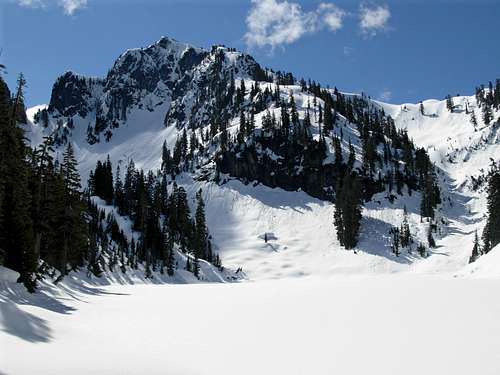
The Alpine Lakes Wilderness is a large wilderness area spanning the Cascade Range of Washington state in the United States. The Wilderness is located in parts of Wenatchee National Forest and Snoqualmie National Forest, and is approximately bounded by Interstate 90 and Snoqualmie Pass to the south and U.S. Route 2 and Stevens Pass to the north. The Alpine Lakes is the largest wilderness area near the population centers of Puget Sound, at approximately 390,000 acres (1,600 km²)

Page Type: Area/Range
Location: Washington, United States, North America
Activities: Hiking, Mountaineering, Trad Climbing, Sport Climbing, Bouldering, Mixed, Scrambling
Season: Spring, Summer, Fall, Winter
Elevation: 9415 ft / 2870 m

Enchantment Lake

Sprite Lake

Dragontail ridge

Prusik Peak

Jewel Lake
Crystal Lake

Inspiration Lake
The Alpine Lakes Wilderness got its name from the 700+ mountain lakes found amongst the majestic rocky peaks and densely forested hillsides of the central Cascades. The official Alpine Lakes Wilderness Area was created by Congress in 1976 via the Alpine Lakes Wilderness Act as an effort to protect the region in its natural form. The Alpine Lakes Wilderness is approximately 394,000 acres. There are currently 47 official trailheads and 615 miles of backcountry trails within the wilderness area.

In 2009, legislation would be reintroduced to expand the western side of the Alpine Lakes Wilderness by over 22,000 acres, as well as grant the Middle Fork Snoqualmie River and Pratt River each "National Wild and Scenic River" status. 
Cascade Mountain
Cascade Mountain
Bald Eagle Peak and Silver Eagle Peak
The Alpine Lakes Wilderness has over 22 notable mountains, ranges and peaks. They are split up into 5 different sections of the wilderness area including:
Guye Peak

Snoqualmie peaks

    • Chair Peak — 6,238 ft (1,901 m)
    • Guye Peak — 5,168 feet (1,575 m)
    • Snoqualmie Mountain — 6,278 ft (1,914 m)
    • Lundin Peak
    • Red Mountain
    • Kendall Peak — 5,784.03 ft (1,763 m)
    • Mount Thomson — 6,554 ft (1,998 m)
 

Dutch Miller Gap peaks

    • Chikamin Peak — 6,960 ft (2,121 m)
    • Lemah Mountain — 7,480 ft (2,280 m)
    • Chimney Rock — 7,721 ft (2,353 m)
    • Overcoat Peak — 7,432 ft (2,265 m)
    • Summit Chief Mountain — 7,464 ft (2,275 m)
    • Mount Hinman — 7,492 ft (2,284 m)
    • Mount Daniel
    • Mount Daniel — 7,899 ft (2,408 m)

Wenatchee Mountains 


    • Cashmere Mountain — 8,501 ft (2,591 m)
    • Eightmile Mountain — 7,996 ft (2,437 m)

Chiwaukum Mountains

  • Big Chiwaukum — 8,081 ft (2,463 m)
  • Snowgrass Mountain — 7,993 ft (2,436 m)

Stuart Range

  • Mount Stuart — 9,415 ft (2,870 m)
  • Argonaut Peak — 8,453 ft (2,576 m)
  • Dragontail Peak — 8,840 ft (2,694 m)
  • The Enchantments


Natural History & Ecology

 The history of the formation of the Cascade Mountains dates back millions of years ago to the late Eocene Epoch. With the North American Plate overriding the Pacific Plate, episodes of volcanic igneous activity persisted. In addition, small fragments of the oceanic and continental lithosphere called terranes created the North Cascades about 50 million years ago. The wilderness was originally designated the Alpine Lakes Limited Area in 1946, but this designation did not offer protection from resource extractions and was exclusively regulated by the United States Forest Service.


Over 2 million years ago, glaciation advancing and retreating repeatedly scoured the landscape leaving deposits of rock debris.  The last glacial retreat in the Alpine Lakes area began about 14,000 years ago and was north of the Canadian border by 10,000 years ago. The “U”-shaped cross section of the river valleys are a result of that recent glaciation. Uplift and faulting in combination with glaciation have been the dominant processes which have created the tall peaks and deep valleys of the Alpine Lakes Wilderness area.


 Geology 


The Alpine Lakes Wilderness features some of the most rugged topography in the Cascade Range with craggy peaks and ridges, deep glacial valleys, and granite walls spotted with over 700 mountain lakes. Geological events occurring many years ago created the diverse topography and drastic elevation changes over the Cascade Range leading to the various climate differences. These climate differences lead to vegetation variety defining the ecoregions in this area. The elevation range of this area is between about 1,000 feet (300 m) in the lower elevations to over 9,000 feet (2,700 m) on Mount Stuart. 

Mount Stuart
Intrusive Igneous
 The most common rock type in this area is intrusive igneous, which are highly fragmented granitics, this includes most of the Foss Lakes and Enchantment Lakes area. The other major rock types are sedimentary, metamorphics, ultrabasic rock complex and the extrusive igneous group that include basalt, andesite, and ryholite. The metamorphic rocks are primarily in the northern part and the southern area is made up of volcanic and sedimentary rocks. The Wenatchee Mountains are mostly composed of peridotite.


Ecology


 The Alpine Lakes Wilderness is considered by the U.S. Environmental Protection Agency to be in the North Cascades ecoregion, dominated by forests, subalpine, and alpine ecozones. Indicator tree species of individual zones include the Western Hemlock, Silver Fir, Subalpine Mountain Hemlock, Subalpine Fir, and Grand Fir/Douglas Fir.


Western Hemlock

Subalpine Mountain Hemlock


Silver Fir


Douglas Fir

 
The Alpine Lakes Wilderness offers an abundance of diversity in both plant and animal species. The Alpine Lakes Wilderness and its old growth forests offer critical habitat for many species on the Washington State Department of Fish and Wildlife’s “Species of Concern” list which includes: 
Western Spotted Frog

Townsend’s Big-eared bat
Fisher
Wolverine

Lynx
 Alpine Lakes Wilderness has diverse wildlife, as well. Large mammals such as black bear, elk, white-tailed deer, mule deer, cougar, and coyote can be found throughout the region. Small mammals such as bobcat, beaver, otter, badger, wolverine, mink, and weasel are also found in sporadic populations. Grizzly bears and wolves are also found in the region, but with still very small populations. Birds commonly seen throughout the area include ruffed grouse, white-tailed ptarmigan, Stellar's jay, ravens, chickadees, hawks, eagles, and woodpeckers. The region is also home to multiple amphibian species of frogs and salamanders, as well as multiple reptile species of lizards and garter snakes. Various fish species of salmon and trout, including native cutthroat trout, inhabit alkes, rivers, and streams within the area.